
Solo...Lone Wolf...
Hiking Big Bend National Park alone.

Big Bend got part of its name from the recognizable sideways S-shaped bend in the Rio Grande river (or el Río Bravo del Norte as it’s known in Mexico). The river designates Texas’ southern border with Mexico, and in particular the Mexican States of Chihuahua and Coahuila.
Big Bend got the rest of its name by being big. Big Bend National Park itself encompasses over 800,000 acres, and has 200 miles of hiking trails, 300 miles of roads, almost 200 miles of scenic river, and 6,000 feet of elevation between the river and the park’s highest point (Emory Peak) in the Chisos Mountains.
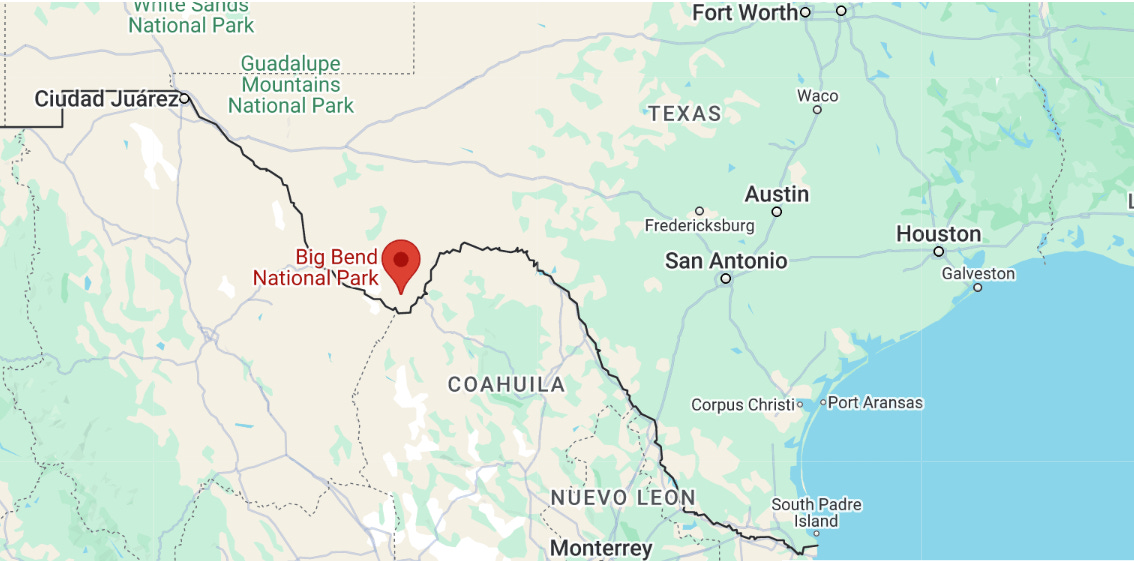
Big Bend National Park was established in 1944, and along with Maderas del Carmen in Mexico, and the adjacent Big Bend Ranch State Park in Texas, together represents over 3 million acres of contiguous protected land — an area almost as large as the US state of Connecticut, and the largest protected section of the Chihuahuan desert, which itself is the largest hot desert in North America.
Big Bend is also remote … the end of the road. You have to want to get there, as it’s not a place you will see while passing through; it’s out of the way. But, evidence of human presence in the area dates back 12,000 years. The Comanche raided Mexico through this area in the 1800s. The Mariscal Mine produced much of the mercury for the United States in the early 1900s. Almost 600,000 visitors came to the park in 2024, almost double the number just 10 years ago. I suspect they are drawn by the same unique qualities that I enjoy — deafening quiet, endless beautiful views, the darkest night skies for stargazing of any park in the lower 48 states, difficult but rewarding hiking, a soak in the hot springs or cool river, a trip across the border for lunch and a cold beer in Boquillas del Carmen (passport required).
In January, I was drawn to the challenge of a few days of solo backcountry hiking and camping. The lodge and restaurant area in the Chisos Basin will close in May, and much needed renovations and improvements will begin, extending the closure and access to much of the park for the next two years.


Solo hikes and backcountry camping are not for everyone.. “Oh yay, pooping on the ground,” I can hear my friend, Michelle, saying, sarcastically. It’s not the Four Seasons.
Even some experienced backcountry hiking friends also expressed concern about me going it alone. “I haven’t been brave enough to solo,” on wrote. Therefore, Solo, Lone Wolf; these were proposed trail names for me on this excursion. In fairness, this is a place, and trails and campgrounds, I have frequented before; I wasn’t going someplace new to me.
But, this is a strenuous hike. I did a 3-day and 2-night figure eight route through the Chisos Mountains. I totaled 20 miles of hiking and about 6,000 feet of elevation change, while carrying a 55 pound backpack. One of the extra challenges of Big Bend is that you must carry all your water; about 8 pounds per gallon, and at least one gallon required per day.
There are dangers. This is mountain lion and black bear habitat, and rangers and numerous signs warn you to be on the lookout. One could also get injured or lost. Just a little over one year ago, a 25 year old gal named Christy Perry of Houston survived after being lost for 8 days. She was hiking the Lost Mines trail, one of the most popular trails in Big Bend; an out-and-back five mile trail that is well traveled and well marked. Her family reported her missing after five days when she did not show up for work. She had flown, alone, to Midland, rented a car, and driven to the park. She never showed up at her reserved campsite, and her rental car was found at the trail head. US Border Patrol agents, Texas Parks and Wildlife game wardens, local fire crews, National Park Service staff, helicopters and canine all searched for Ms. Perry.
She was found 1/4 of a mile off the trail. She shared a series of photos on TikTok after her rescue that documented her ordeal; a happy solo hike that quickly turned into a near-death experience. Evidently, heavy rain and thick fog settled in, drastically reducing visibility. Having gotten off the trail accidentally, then lost and disoriented, she hunkered down in a ravine and survived by drinking rain water that collected in puddles in rock formations. The wet conditions that contributed to her getting lost also ended up saving her life.
Ms. Perry made some critical mistakes — traveling alone, she hadn’t informed anyone of where she was going; once hiking, she had no way to communicate (no cell phone service); she most likely had not checked the weather forecast; she likely had no compass, paper trail and terrain map, or means to navigate; thinking she was just out for a quick day hike, she carried no food with her; while she did have a light jacket, she wasn’t prepared with waterproof or warm layers; she had no shelter (or emergency blanket or bivvy bag); she had no whistle, or light (after her phone battery died), or mirror for signaling to all of those searching for her; she almost certainly wasn’t carrying bear spray or any way to protect herself. So, while there are certainly risks, thoughtful planning can mitigate those risks and ensure a safe outing. A bit of planning would have made all the difference; Thank God for all those search and rescue heroes.
Tennis Channel used to do a segment called “what’s in your bag?” I’ll do a version of this, and highlight some tips and tricks that I hope some find useful. Even better, I hope you get the motivation and courage to try an experience like this.
Planning. Planning for me starts with a route and itinerary, and securing required permits and camp site reservations. Next, I detail everything I need and want to pack and carry in a spreadsheet that includes every item’s weight. I lay everything out on the floor, load the pack, and test it out. Shakedown hikes, or trial runs, even if just walking around your neighborhood, are great for seeing how everything feels. Next, I try to optimize for weight, or get lean; take what you need, but not more than you need. I unpack, doublecheck everything, and repack.
Navigation. For navigation, I always have paper and digital maps handy on long treks. National Geographic has great maps for major parks and trails. The National Park Service with also have paper maps available (or you can download the map from their website and have it on your phone). I also love the AllTrails phone app, and will download the specific trail for my trip. Your phone has a compass app (a small and light physical compass is good to have, too). Digital gadgets are great, but make sure everything is fully charged before departure. And, I carry an Anker A1271, a 21,100mAh USB rechargeable battery pack which weights 12.5oz; in backpacking terms, it’s heavy, but a choice I make to ensure I can recharge dead gadgets. The paper map my handy and an always-ready back-up.
Communication. An important part of communication is letting folks know where you will be going; so, pre-plan your routes, reserve your camping sites, and let folks back home (and park rangers) know your route and timeline. Big Bend, and many remote National Parks and national forests have little to no cell phone coverage. I use a Garmin inReach® Mini 2 Satellite Communicator to send daily check-in text messages; it can also be used to send SOS messages and accurate GPS location, if needed. It’s light, only 3.5oz. You can usually find them on sale for $299, plus a monthly subscription (which you can turn on or suspend, as needed) will run about $35. If you hike with others, only one is needed and you can split the cost. If alone, it’s worth the security and safety, in my mind.
Hydration. In general, you can only survive without water for three days. But even for day hikes, I am always amazed by those I encounter on a trail that head out without proper, or any, hydration. One should plan on consuming a gallon of water per day, minimum; then, additionally consider the exertion and temperatures for your particular trip. If reliable water sources are available along the route, then I usually plan on three methods to filter and make safe-to-drink that water; I have a Platypus GravityWorks filtration system, and take Aquatabs chemical tablets as a back-up, and lastly have a JetBoil Flash cooking system and fuel with which to boil water. If in the Chisos Mountains in Big Bend, you have to carry all your water (as there is none available); a bit over 8 pounds per gallon. I like carrying 1L Smart Water bottles simply because they are easy to cram in the pack. For this trip, in January, I knew it would be cool during the day, and cold at night. I also planned on starting around mid-day on Wednesday, and being off the mountain mid-day on Friday; that allowed for hydrating before the start, and after the finish (with supplies in the truck). So, for this trip, I carried two gallons of water on the trail in the form of two 28oz Gatorade Zero bottles and six 1L Smart Water bottles. I also had electrolyte tablets to mix with the water, if needed. My burn rate looked like this — I was well hydrated before starting; I consumed the two Gatorade on the first afternoon’s hike; in camp, I use 1L of water for dinner, and 1L of water for breakfast the next day; I consumed two liters of water during hiking Thursday and Friday; upon completion, I fueled up at the truck. Additionally, I took some mandarin oranges to eat during the hike.
Illumination. I always take a headlamp, even on short day hikes. Once, about 30 years ago, we go lost in the Quachita National Forest; a day mountain biking trip went wrong, we got lost, and ran out of daylight. Take a headlamp; they are cheap, and light, and good to have to see where you are going, what you are doing, and if need be, use for a signal for others searching for you.
Food. Planning food for a backcountry trip, for me, is about balancing calorie density and taste with weight. I have settled into a predictable routine. Breakfast is French press coffee (because I’m not an animal, and a wonderful hot cup of coffee, especially in primitive conditions, reminds you that you’re human), a couple of mandarin oranges, and a small bar. I like Kate’s Real Food bars which are about 2oz, 120 calories, and 4g of protein. Lunch is a bagel with peanut butter and honey; bagels stay fresh for several days, and small packets of peanut butter and honey travel well. Dinner is a pack of peanut butter crackers (180 calories), and a brought-back-to-life dehydrated meal. My favorite brands are Peak Refuel and Backpacker’s Pantry, which provide around 1,000 calories and 50g of protein, and offer surprisingly great-tasting options. Dehydrated meals are eaten from their bag, and when done those same meal bags can double as sealable trash bags. I usually have hot tea with dinner, and a 72% cacao Ghirardelli chocolate square for dessert. I mentioned the JetBoil and its fuel; it’s put to work for dinners and breakfasts. Also required is a basic camp spoon, a mug for coffee and tea, and a knife. I have a bear-proof food canister which I use on backcountry trips where bear-proof boxes are not provided in campsites.
Shelter. Even for day hikes, I highly recommend a SOL brand emergency blanket or bivvy bag (either are less than 4oz, and cost $20 or less). Their slogan is expect the unexpected; which reminds me of the warnings my older brothers would give me growing up — when you least expect it, expect it (which usually preceded a beating). For overnights, I sleep in an Ascend one-person tent (and stakes), with a good down sleeping bag, an inflatable pillow, and Kilo Gear sleeping pad. A small Flextail or similar USB-rechargeable inflator-deflator is a luxury. Ear plugs are nice to have, especially on windy or loud nights. I carry a few Hothands hand warmer packets; one or two placed near your feet in the sleeping bag on very cold nights is a game changer. If I can spare the weight, I also like to have a Helinox camp chair, and a pair of around-the-camp shoes (Crocs or Frogg Toggs); after a rough day of hiking, it is really nice to sit comfortably and get out of the hiking boots.
Gear and Clothing. Proper high-quality, and broken-in, hiking boots are a must; I wear Merrell Moab 3s. I am a fan of DarnTough Vermont-made wool hiking socks. I also like using collapsible trekking poles. I always wear a hat. A very light down puffer jacket, a sock hot, and gloves are great for colder evenings and mornings. If it’s going to be super cold (and for me, that’s low 30deg F or less), I bring long johns for the evenings. I hike in Kuhl pants or Free Fly shorts, depending on temperature. I like to wear a light long-sleeve hooded shirt on top. Beyond that, I plan for layers based on conditions; and I re-use clothes on the trail to save weight (one socks and underwear get refreshed daily). I carry a small camping trowel, a bit of toilet paper, and Dude Wipes; because, well, that has to happen every day, and you may or may not have access to facilities. Take an extra trash bag; leave no trace. When around bears, I carry bear spray. I carry a small first-aid kit with essentials, including ibuprofen, sunscreen, chap stick, and prescription medications. I like to have music, a podcast, and a book downloaded to my phone for entertainment in the evenings and mornings.
This time at Big Bend, I covered the following trails — Pinnacles, Boot Canyon, Colima, Laguna Meadows, Blue Creek, South Rim, and East Rim. I camped at Blue Canyon and the East Rim.
From the South and East Rim, you can see all the way to Mexico; it’s spectacular. The hills and canyons you traverse wildly vary, and it is breathtakingly beautiful. When hiking with my son when he was younger, he was great at forcing frequent breaks — to have a snack, a drink, and sometimes to take our socks and boots off to air out the toes — from my son I learned to slow down, take in the view, and enjoy the experience.
On the way to the East Rim, I passed a spot that I remember well from few years ago. I was with a group of friends, and my son when he was much younger. I was carrying his and my water both, which made for a heavy 70-plus pound pack, and I was not in as good a physical shape as today. Add that I probably hadn’t eaten or drank enough that day, and I really started to crash. My friends recognized I was in trouble and made me stop, got some food and water in me, helped me recover, and got me to camp that night. When you are traveling alone, you have a lot of time and quiet to think; on that particular stretch of trail, I got to thinking a lot about friends who help you through challenges, large and small.
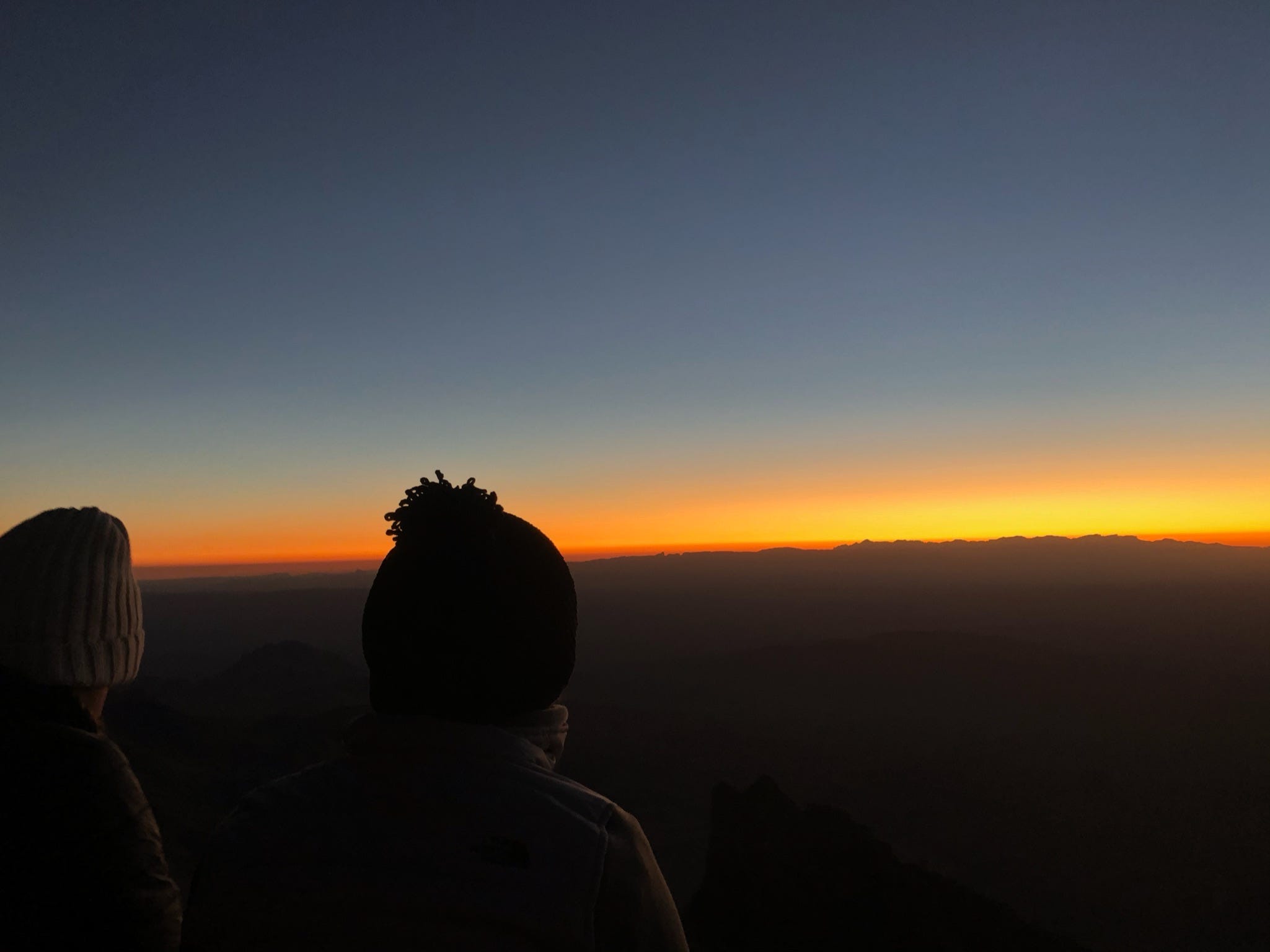
At our favorite campsite on the edge of the East Rim, another memory flooded back. On yet another backpacking trip a few years ago, in December 2020, I was with some guy friends and some of their kids. I was blessed to have my daughter, one of her best friends, and my son with us, too. I am so proud of my kids for gutting out such a trip, and getting to experience it all; when faced with a challenge, they will have this memory to build confidence. One of my absolute favorite pictures of all time is below; my daughter and her friend, up before sunrise (which for teenage girls is a miracle), sitting in the freezing cold with all of us, having coffee, and watching the sun rise over the mountains in Mexico.
One night during that trip, the girls retired early to their shared tent; you can’t have a fire in Big Bend National Park, so when it’s cold and dark, it sometimes means getting into your tent and sleeping bag quite early. The old men (dads), and grown and younger boys, stayed up a bit longer that night. The boys were stargazing and counting satellites, while the dads were talking, telling stories, laughing, and sharing a nightcap bourbon. As the girls huddled in the their tent, my daughter's friend told her, “I hope when I get older I have close friends, like your dad.”
Freezing temperatures and gale force winds howling all through my final camping night had me motivated to return to civilization. I was packed and on the trail by 8:30am, and covered eight miles in four hours to complete my trip. A cold beer awaited me in the ice chest in my truck; a well-earned reward. And, one of our traditional guilty pleasures is to stop at a place in Fort Stockton on the drive home, called B’s Family Diner; hand-cut fries, and a great burger await. Another great saying from my son when he was much younger, “you have to get off the interstate to discover a place like B’s.”
This will surprise no one who really knows me, or worked with me for all those years, but when given a Myers-Briggs (or similar) personality test, I rate as an extreme extrovert. I love a heartfelt handshake or a warm bear hug. I get energy from being around other people at a party, a meeting, or conferences. I suffer from severe FOMO. On my solo hike, I encountered maybe 15-20 other humans per day; most of my days, and all of the time in camp, was quiet, and alone.
But I like being alone from time to time, to read a book, to think, to observe, to recharge. Hiking and backcountry camping allows me to do that. It also allows me to exercise my engineer’s need to plan and prepare, to obsess about gear, and weight, and calorie content, and routes, and what ifs. I love taking in the beauty and peace of being outdoors. I like accomplishing things, and after a slow and methodically-paced day, I can look back at the ground covered and see what I have done. I also like a challenge, and find that being a bit uncomfortable keeps me on my toes, while making me appreciate simple things — a good meal, a warm bed, the company of friends and family — that much more.
So, step away from social media, or 24-hour news, or … and go for a hike!
And for Jake and Karissa … I use a EXO Mountain Gear K3 4800 backpack that Jake talked me into! You can probably fit an entire moose in it, although I’ve never tried. (I’d bet Jake has!!!)
Hello David. Thanks for sharing this. I love hearing others perspectives on hiking and self reflection while on the trail. I’ve spent a great deal of time out in Big Bend. Both the NP and SP. my recent favorite from March was Upper Burro Mesa trail. You need to add that one to your list. Also, I’ll share here but not anywhere else. Cattail fails. It’s protected and not on any maps. I met an amazing couple out there and was honored to take there anniversary photo. Add 5 lbs to a pack for carrying that. lol. Interestingly, I’m about to get on my treadmill with 30lbs. I’m prepping for a beginners backpacking trip in November. I haven’t reserved my spot but I want to. Small ailments, such as anxiety (in certain situations) and asthma have kept me from doing this for many years. And then I see the Big Bend 100, and of course would love to see all of BB on foot, but figured I need to start somewhere. So hopefully I’ll accomplish this first step. One of your photos you share was of the South Rim that had caught fire. My brother and I were slated to backpack your same route a few years ago. I was training with 55lbs and felt ready. Lightening struck a few months before our trip and our backcountry reservations were canceled. We still made the trip and camped below the basin. When we arrived at the basin for a day hike, the trail only was open to the south rim so we decided to hike to Laguna Meadows and turn around. I made it about 3.5 miles with 30 lbs on my back and had to turn around. Appointments later, I found I have a high heart rate have been treating that and is under control. I always think back to that fire that hurt to see, hurt because it ruined a trip, not just a back packing trip but a trip with my brother, but also the fact that it prevented me from making a huge mistake. I’m afraid I would have pushed myself to continue going if that day was day one of the back packing trip and not just a “day hike”. It could’ve made for a bad trip. I’ve learned a lot about listening to my body but sometimes that doesn’t pair well with bits of anxiety. lol. It’s kept me, up till now, enjoying the park on day hikes and camping out of my truck while in BB. As most are, I’m grateful for every opportunity I get out there. Usually twice per year. I plan to be out there in November and my usually January trip. Sorry for the long reply. Good to see you yesterday at the 765kV summit. (That does bring other mixed feelings when I hear 765kV and Big Bend in the same sentence.) Hope to see you on the trail one day.
Gabe Santos